

A preschool curriculum is the intentional plan a school follows to build a child’s language, math, social-emotional, and motor skills through daily activities, not just free playtime with adult supervision. A strong curriculum blends structured lessons with hands-on exploration, so children are learning even when it looks like play.
Below, we break down what a quality preschool curriculum should include, how STEAM based programs like AEA’s build on that foundation, and what to ask about the next time you tour a classroom.
In this article
- What does “preschool curriculum” actually mean?
- What should a preschool curriculum include?
- What is STEAM curriculum in preschool?
- Play-based vs. structured curriculum
- How does curriculum grow with a child?
- How AEA builds this into every classroom
- FAQ
What Does “Preschool Curriculum” Actually Mean?
At its core, a curriculum is simply a plan: what gets taught, in what order, and how progress gets measured. In preschool, that plan usually blends a few core learning domains:
- Language and early literacy
- Math and problem solving
- Science and the natural world
- Social-emotional skills
- Fine and gross motor development
A quality curriculum weaves all five into daily routines, rather than treating any single subject as a stand-alone lesson.
What Should a Preschool Curriculum Include?
When you tour a classroom, it helps to know what you’re actually looking for. Here’s how the core learning domains typically show up day to day:
| Learning Domain | What It Builds | Example Classroom Activity |
|---|---|---|
| Language & Literacy | Vocabulary, letter recognition, storytelling | Circle time read-alouds, name recognition games |
| Math & Reasoning | Counting, patterns, early problem solving | Sorting games, building block challenges |
| Science & Discovery | Curiosity, observation, cause and effect | Simple experiments, nature exploration |
| Social-Emotional | Sharing, turn-taking, self-regulation | Group projects, guided conflict resolution |
| Motor Skills | Coordination, balance, fine motor control | Art projects, outdoor movement activities |
What Is STEAM Curriculum in Preschool?
STEAM stands for science, technology, engineering, arts, and math. Rather than treating these as separate subjects, a STEAM curriculum builds them into hands-on projects that mirror how children naturally explore the world, like building a tower, mixing colors, or asking why the sky is blue. In a preschool classroom, that usually looks like:
- Science: Simple experiments and nature exploration, like planting seeds or observing how ice melts
- Technology: Age-appropriate tools, from a magnifying glass to a classroom tablet used for a specific learning activity
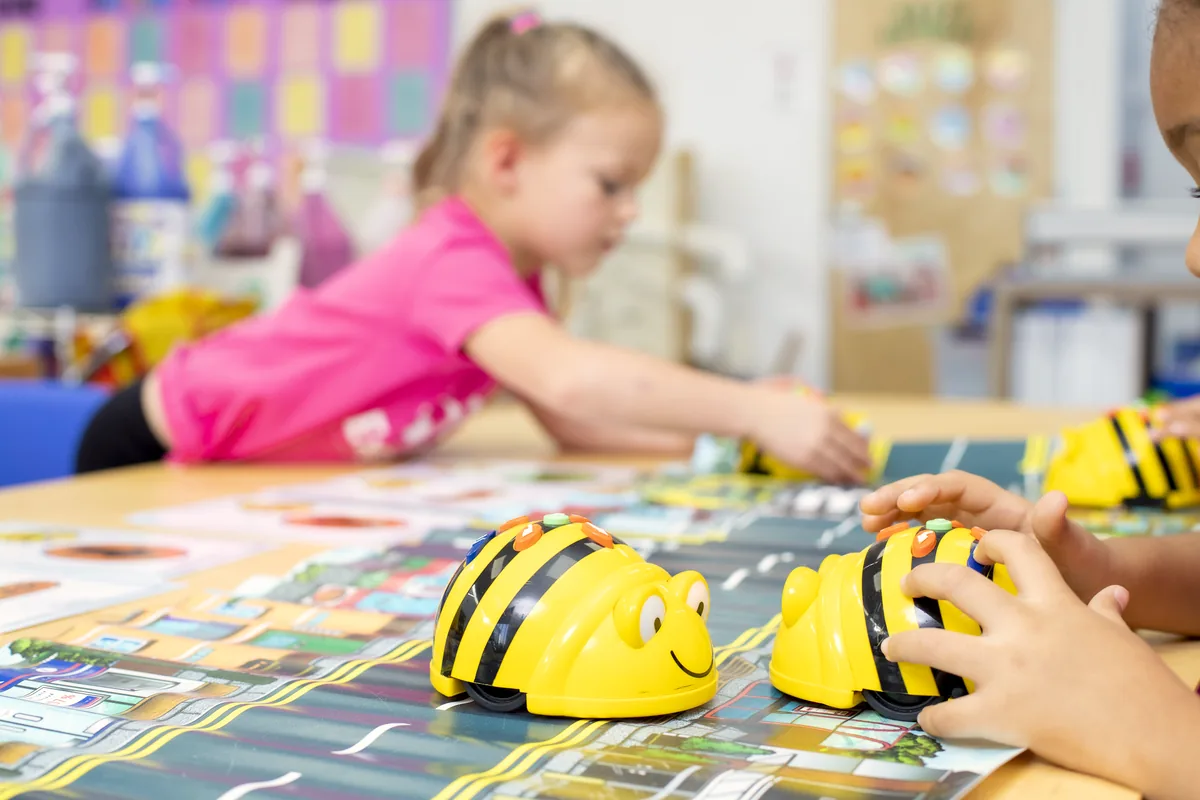
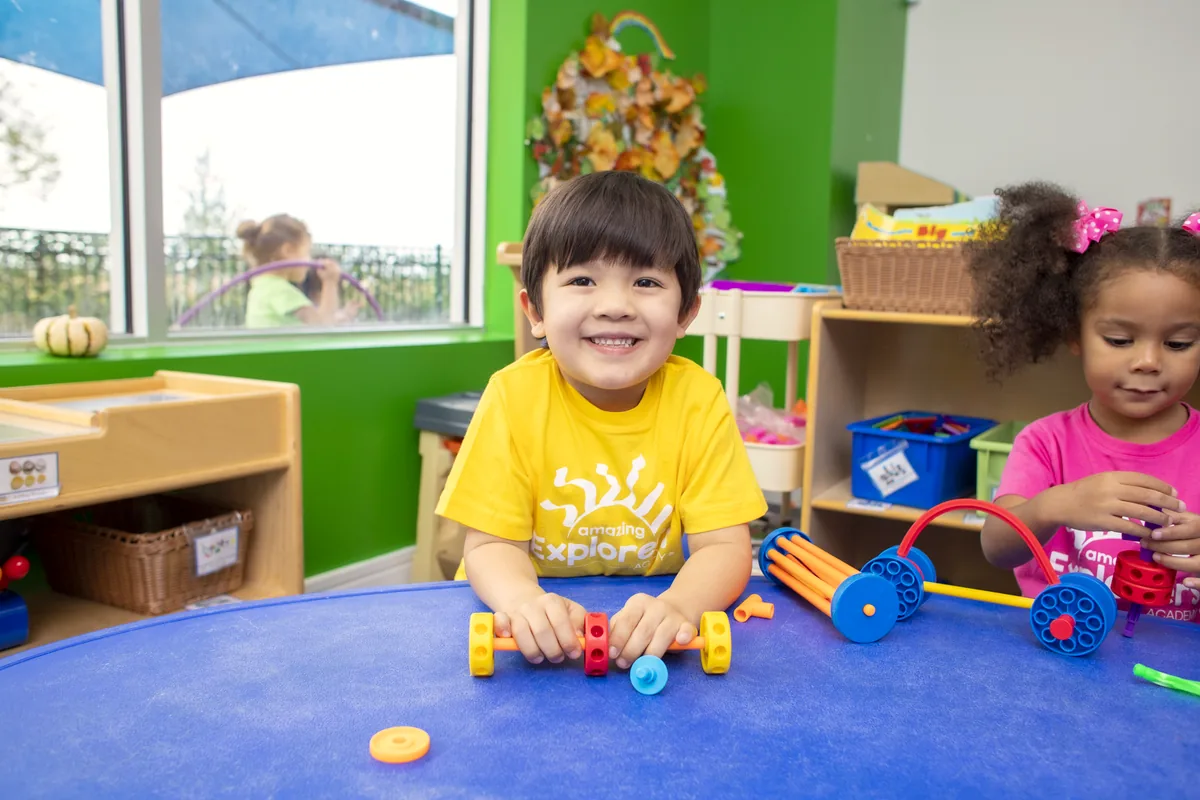
- Engineering: Building challenges with blocks, ramps, or recycled materials that involve trial and error
- Arts: Open-ended art projects and music that build fine motor skills and self-expression
- Math: Counting, sorting, and pattern recognition worked into everyday routines, not just worksheets
At AEA, STEAM is not a once-a-week add-on. It’s woven into the daily curriculum across every classroom, from sensory exploration in our youngest rooms to structured science and engineering projects as children get closer to kindergarten.
Play-Based vs. Structured Curriculum: What’s the Difference?
Not all preschool curricula look the same. Two common approaches:
- Play-based curriculum: Learning happens primarily through child-led, open-ended play, with teachers guiding and extending it.
- Structured curriculum: Teachers lead more direct lessons on specific skills, often on a set daily schedule.
Most quality programs, including AEA’s, blend both. Children get dedicated time for open-ended, child-led exploration alongside more structured group lessons, so learning stays engaging without losing intentionality.
How Does Curriculum Grow With a Child?
A good curriculum is not one-size-fits-all across every age group. Classrooms with younger children lean more heavily on sensory play, routine, and language exposure. As children get older, the same core domains, literacy, math, science, social-emotional, and motor skills, get layered with more structure, longer group activities, and school-readiness skills like following multi-step directions.
By the time a child reaches Voluntary Pre-Kindergarten (VPK) in Florida, the curriculum should be actively preparing them for a smooth transition into kindergarten.
Questions to Ask When You Tour a Classroom
A brochure can tell you a program has “curriculum.” A classroom tour tells you whether it’s actually working. A few things worth asking:
- Can you walk me through a typical day, hour by hour?
- How do you balance structured lessons with open-ended play?
- How does the curriculum change as my child moves up in age?
- How do teachers track and share my child’s progress?
- What does a STEAM project actually look like in this classroom?
A teacher or director who can answer these clearly, with real examples instead of general marketing language, is usually a good sign the curriculum is more than a document on a shelf.
How AEA Builds This Into Every Classroom
At Amazing Explorers Academy, every classroom follows our STEAM based curriculum, built around hands-on projects, guided play, and age-appropriate school-readiness goals. Whether your child is just starting out or getting ready for VPK, the same core philosophy carries through every classroom: learning should be hands-on, curious, and fun.
Tour a classroom and see how our curriculum comes to life, from our youngest learners through VPK.
Frequently Asked Questions
What is a preschool curriculum?
A preschool curriculum is the structured plan a school uses to build language, math, science, social-emotional, and motor skills through daily activities and guided play.
What should a preschool curriculum include?
A strong curriculum touches five core areas: language and literacy, math and reasoning, science and discovery, social-emotional skills, and motor development, woven into daily classroom routines.
What is STEAM curriculum in preschool?
STEAM curriculum builds science, technology, engineering, arts, and math into hands-on classroom projects, rather than teaching them as separate subjects.
Is play-based or structured curriculum better?
Most quality programs blend both, giving children time for open-ended play alongside more structured, teacher-led lessons.
Why does preschool curriculum matter?
A strong curriculum makes sure the time your child spends in the classroom is building real skills, not just passing time, and helps set them up for a smoother transition into kindergarten.
See Our STEAM Curriculum in Action
Now enrolling ages 6 weeks to 12 years across our locations.