
Supporting your child in growing as their best self is a top priority for any parent. To honor that commitment, investing in socialization in early childhood is key to ensuring they develop as skillful adults and have the right repertoire to handle complex situations.
Healthy interactions with adults and other kids is critical for them to become problem-solving individuals and develop clear communication, tolerance, empathy, flexibility and emotional intelligence.
In early education, schools take a lot of responsibility for teaching and socializing children, but parents can also play a big part in this learning process. Socialization happens naturally in a child’s life and it can get strengthened beyond school time by their parents.
Now, how can you encourage your kids’ socialization skills? To help you collaborate with your child’s development, we gathered nine ideas and attitudes that can help you boost their social skills.
Keep on reading!
Why Is Socialization Critical In Early Childhood?
Firstly: socialization means more than simply being sociable around other people. It’s way more complex than being chatty and responding to conversations when others talk to you.
Socialization also means scanning and recognizing the people that are around you. Knowing when you might be close to someone that is not safe or even understanding when to step up to a situation that is not right, and it’s happening in front of you.
It’s not about growing your kids into becoming a vigilante or anything like that. But we do hope that we raise sensible and thoughtful people that will be a positive force in society.
Investing in socialization in early childhood is also a tool to help the child realize that the world is not restricted to their views and beliefs. Interacting with different people, with diverse stories, backgrounds, and perspectives can have so much positive impact in their future.
Socialization Development Milestones in Early Childhood
But socialization skills don’t happen overnight: it grows step by step, just like walking or talking. It starts early at home, where children first learn how to connect with others through family interactions.
As they grow, preschool and playtime with peers become key to expanding these skills, helping Little Ones to understand teamwork, sharing, and emotional awareness in a broader world.
Recognizing Social Cues
In the first years, children begin to notice facial expressions, tone of voice, and gestures. This is the foundation of understanding others’ feelings.
This means that a toddler might start comforting a crying friend or laugh when others do—small signs that they’re getting emotional cues.
Sharing and Taking Turns
Around preschool age, kids start learning the tricky art of sharing toys and waiting for their turn.
It’s not always easy! But each time they practice, they build patience, fairness, and cooperation, abilities that will serve them well in friendships and group settings later on.
Building Friendships
By age four or five, children begin forming genuine friendships. They start to seek out specific playmates and express care for their friends’ happiness.
This stage helps them understand loyalty, empathy, and mutual respect.
Managing Emotions and Conflicts
Preschoolers gradually learn to name their emotions and handle small disagreements, like deciding who goes first in a game.
Learning to manage frustration or disappointment is a big social milestone and an early sign of emotional intelligence.
How Preschool Encourages Socialization Development
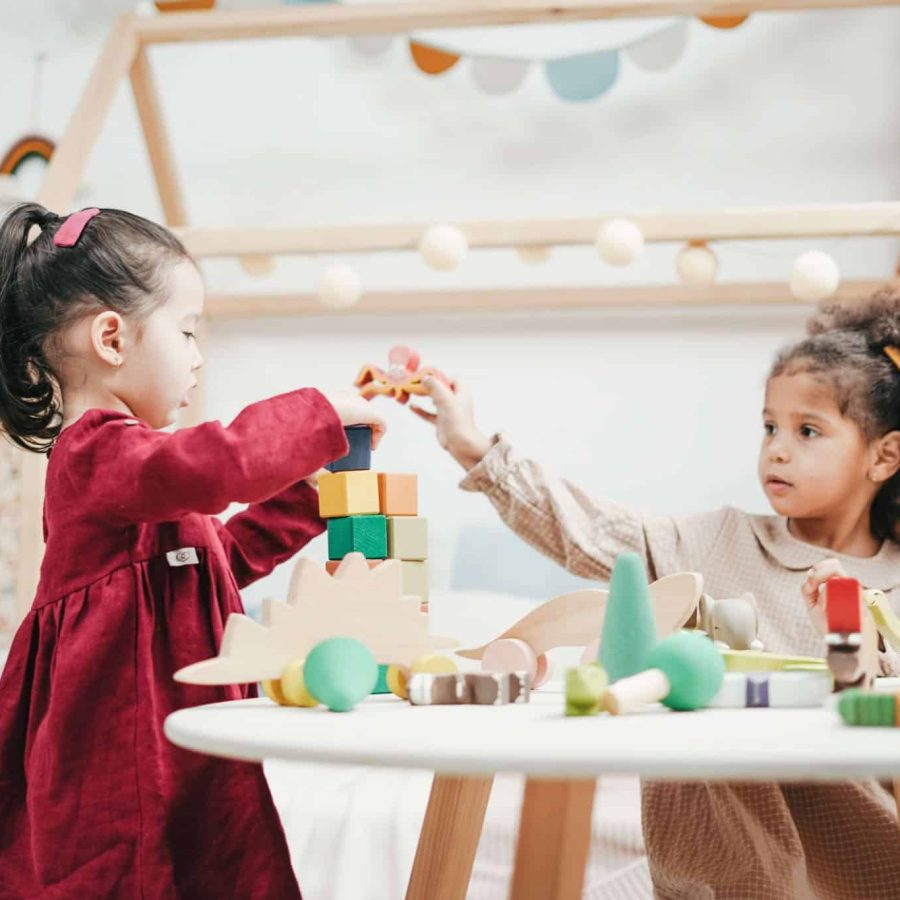
Preschool is where many social lessons truly come to life. In a group setting, children learn how to share, cooperate, and understand others’ feelings—all while having fun.
A child has plenty of opportunities to practice social skills in preschool. During circle time, children listen, take turns speaking, and learn to express their thoughts respectfully. Cooperative games and group projects teach teamwork and patience, while pretend play helps them experiment with roles, emotions, and problem-solving.
Many early education programs use the STEAM approach, which integrates Science, Technology, Engineering, Arts, and Math. What makes it so powerful is that most STEAM projects naturally require collaboration
Whether building a simple structure together or creating a group art piece, children must plan, communicate, and make joint decisions. These shared tasks not only build curiosity and creativity but also strengthen empathy, leadership, and confidence.
How To Improve Socialization In Early Childhood
Developing socialization in early childhood is way more than taking the children to play with others (although this is a step you shouldn’t skip!).
It’s about positioning you, a parent, as a role model. As someone who celebrates their social achievements and is motivating them to continue to build their social connections with other kids.
Learn what is your part as you aim to contribute with your child’s socialization.
Choose Trustworthy Environments
It’s only natural that we, as humans, feel safer and more at ease when we are in a place that makes us feel good.
When it comes to making room for children to socialize, it’s fundamental to introduce them to a place where they are comfortable, where they have enough room to play and see other children happily interacting with each other.
It’s likely that they’ll feel more open to engage with other peers and create strong connections. That’s why it’s so important to choose the places your child will attend.
Follow the Child’s Interests
Adults sometimes can have this idea that they are going to shape the child to later become exactly what they want them to be. Remember that besides your expectations as a caregiver, children also have their own interests and it is very important to stimulate them to understand who they are.
Be open minded, observe and allow them to express their personal identity through desires, activities, toys and interests. Once you understand what draws the kid’s attention, use it to introduce socialization: artistic activities like dancing, drawing, singing can work just fine when interacting with other kids, for example!
Model Good Social Skills
Children learn a lot by just observing and mimicking what’s around them. Understanding this and realizing you also have a role in your child’s social skills is so important!
Socialization development in childhood starts with something as simple as a child seeing small actions and feeling the energy that adults and other kids give off around them.
Having that in mind, be aware of how you respond and react to different situations in front of your child. Pay attention to how you deal with conflicts, how you cope with negative emotions.
Do your research about emotional intelligence and be ready to teach Little Ones how to calm down and manage emotions such as anger, frustration and sadness.
Teach Your Child About Empathy
The meaning of empathy consists in the ability to share another person’s feelings or experiences by imagining if you were in this person’s shoes.
This skill is considered a must in the 21st century as we are heading towards a society that demands more communicative and collaborative individuals. Learning it at the early stages of childhood can be a game changer for this future adult.
Through sharing, active listening, eye contact, respecting personal space and being present, we can teach empathy and cause a positive impact even if the child is dealing with uncomfortable emotions and conflicts.
Encourage Your Child to Play With Other Kids
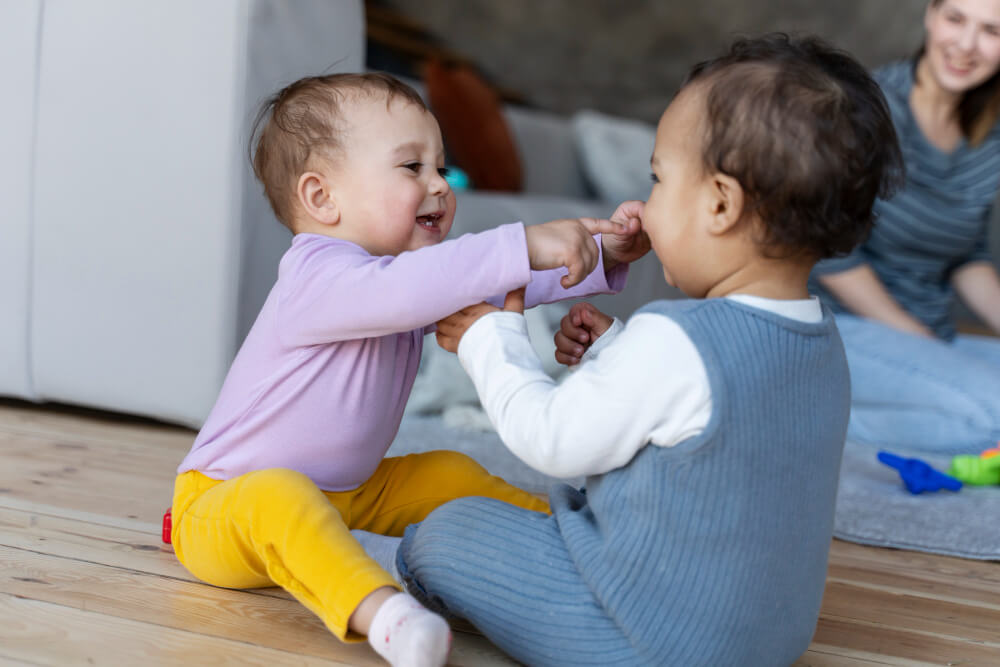
There is nothing better to learn a skill than in the practical way: interacting with other kiddos can be an enriching experience to develop social skills. In the early stages of socialization, children can be a bit skeptical about opening up to other people, especially if they are met with a negative experience beforehand.
Encourage your child to interact and play with other children while being at a park or inviting neighbors, friends and family over. In the beginning, you can also choose other kids that show a more easy-going and approachable behavior to promote a good experience for your child.
Some children will prefer to play and engage with adults because it can be more predictable: they tend to be more easy going and cater to the child’s needs. If you think that is the case, consider doing the opposite of what is expected: some parents start to actively go against what their child expects – having behaviors such as demanding to go first on something, wanting to play another game, or even playing to win.
It might sound counterintuitive, but this practice helps the child to feel more comfortable with small conflicts and also teaches them how to be flexible and adjust to adverse situations.
Show That You Care About Their New Friends
By now, we’ve discussed the importance of being a role model to a child that is learning how to socialize. Also, how to encourage children to meet new peers and make friends. But what else is missing?
It’s not enough to simply celebrate and encourage your children’s social efforts. You can also be a part of it by showing the child you care about their social achievements.
How? As simple as having a conversation! Ask your Little One about their friends: what they do together, what kind of games they play, invite the friend for a sleep-over.
Essentially, make room for the child to express themselves on how they feel about the relationships they’re building.
Having this connection is also important for you, as a parent, to identify if something is off-rail (i.e. a child behaving violently towards other kids) and needs to be addressed.
Be the parent your child trusts. This is mainly possible through conversations and creating a safe environment.
Include Your Child in Group Activities
Socialization in early childhood can be easily stimulated by joining group activities. As mentioned above, discover what your child is into and find groups that share the same interests.
Having a playgroup at a local park, a book group at the library for story time and even taking swimming classes are some activities that can encourage the child to interact with other adults and children.
Attending social gatherings, with family or friends, also can stimulate interaction with other people and boost self expression and self confidence with time.
Give Your Child Space to Solve Problems
Parents and caregivers always have the urge to protect their children: it’s pure instinct. Yet, too much protection can cause a negative effect in a child’s life. Giving space so the Little Ones can figure out how to deal with a specific situation is healthy and stimulates problem-solving skills.
Even though you might have the impulse to help, try not to interfere in every minor problem. Step back and push them a little bit to find a solution themselves. This practice can help them develop self confidence and independence which will interfere in their socialization. Children can do a lot when we don’t give them all the answers.
Role Play With Your Child
We mentioned that children learn through observing and mimicking, right? What could be a better way to teach them something than simulating a situation?
This role play could be particularly important if you feel your child is struggling with a particular feeling. They might feel shy to ask their friend for a sleep-over; or maybe they don’t know how to say they don’t like when another kid takes their toy without consent.
If you invest time and commitment into creating a safe space for your children to confide in you, you’re already up in the game. Show them it’s completely normal to feel embarrassed or insecure, but that doesn’t mean they shouldn’t react appropriately. And you can practice together what would be the best way for the child to express themselves.
What Can Hinder Socialization Development in Childhood?
Every child develops social skills at their own pace, but sometimes certain factors can make this process more challenging. Understanding these influences early helps parents offer the right support and create an environment where children can thrive socially and emotionally.
Some children experience anxiety or attachment difficulties that make it harder for them to feel comfortable in group settings. Others may have gone through trauma or stressful changes that affect their trust or confidence when connecting with others.
Conditions such as Autism Spectrum Disorder (ASD) or Attention-Deficit Hyperactivity Disorder (ADHD) can also impact how children communicate, read social cues, or manage emotions.
The good news is that with awareness, patience, and the right surroundings, children can learn and grow beautifully. Supportive environments, like those that emphasize emotional safety and guided social play, can help children build these essential skills step by step.
Early Socialization Development Takes Time, But It Pays Off!
As you can see, there are a lot of small steps that can encourage children’s social skills. As much as parents and family can introduce and help children develop these abilities, a good early childhood education program is extremely important to stimulate these skills in an environment that brings routine and constant interaction with other children.
Going beyond teaching technical knowledge, it’s very important for children to learn how to be problem-solvers, independent, resilient, have emotional intelligence and clear communication. A high quality educational program will focus on the learning of soft skills to ensure a better future for our children.
Learn more about the importance of early childhood education in our blogpost and learn how to ensure the best education for our children.